
DJ Company Lead Booking Miami: 90 Minutes of Admin to 15
A luxury entertainment company spent 90 minutes of manual admin on every new client. We rebuilt DJ company lead booking around one CRM pipeline and cut it to 15 minutes end to end.
Five years ago we built a booking system for a New York luxury entertainment company, a shop that books bands, DJ artists, and immersive production for high-end weddings and corporate events across the Hamptons, Palm Beach, Miami, and destination markets worldwide. Great talent, a strong reputation, and a growth ceiling that had nothing to do with either. Every single new inquiry cost the two founders roughly ninety minutes of manual administrative work before anyone could focus on the actual event. DJ company lead booking was not their problem. The manual tax on every booking was.
Here is what those ninety minutes actually looked like, because it is the part most entertainment operators recognize immediately. An inquiry comes in through the website. Someone copies the details into a spreadsheet. Someone schedules the initial call by hand and emails a Zoom link, checking two calendars to avoid a double-book. Someone builds a proposal from scratch, looks up the artist's rate, formats a fee table, and sends it. When the client accepts, someone rebuilds the same information into a contract, creates an invoice in a separate tool, attaches it, and emails it. Then the music planner, the artist call, the reminders, the post-event follow-up, all by hand, all living in the founders' heads. Ninety minutes of copying the same information between five tools, per client, before the real work of running an event even started.
The fix was not more staff. It was one connected pipeline that did the copying for them. We rebuilt the entire inquiry-to-booked-event workflow around a single CRM, and the ninety minutes of manual admin per client dropped to about fifteen minutes end to end. That is the number that changed the business, because it handed the founders back the hours they had been spending as their own admin department.
Why Does DJ Company Lead Booking Break Down on the Admin, Not the Leads?
Entertainment companies rarely have a lead problem once the reputation is built. Referrals and repeat planners keep the inquiries coming. What breaks is the middle: the manual, repetitive, error-prone work of moving one client from a first message to a signed contract and a paid deposit. Every one of those steps lived in a different tool, and every handoff between tools meant re-typing the same client name, event date, venue, and fee. The founders were the integration layer, and they were spending the most valuable hours of their week being a copy-paste service.
The cost was not just time, it was focus. Ninety minutes of admin per client, across a calendar full of high-end events, is most of a workweek that could have gone to sales calls, managing the events themselves, or onboarding new artists to scale the roster. The company was growth-limited by the fact that the two people who should have been selling and running events were instead formatting proposals at eleven at night. Speed suffers too, and speed wins bookings: Harvard Business Review's research on the short life of online sales leads is blunt about how fast a fresh inquiry goes cold, and a founder buried in manual admin is a founder answering slowly.
The Booking Pipeline We Built Around One CRM
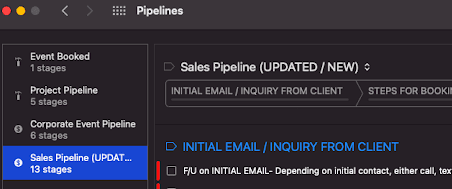
We put a CRM at the center, Daylite, and made it the hub the whole system ran through. When an inquiry comes in through the website or the client books an initial call, a contact and an opportunity are created automatically, and the opportunity carries a sales pipeline that is really a task checklist, inquiry, call, proposal, contract, invoice, event, follow-up. The founders stopped keeping the process in their heads. The pipeline told them the next action on every client, with due dates and reminders, and any step could be handed to a team member without a briefing.
Scheduling moved to Calendly, wired into the same calendars so a double-book was impossible. Three event types, an initial call and two artist calls, each routed to the right founder, with a rule that balanced the load between them and a group-call option that let artists and clients join the same session. Zoom links generated themselves. The client picked a time, and the appointment landed in the CRM with their intake answers attached, no manual scheduling, no back-and-forth emails.
| Step in the booking | Before, by hand | After, through the pipeline |
|---|---|---|
| New inquiry captured | Copied into a spreadsheet manually | Auto-creates a CRM contact and opportunity |
| Initial call scheduled | Two calendars checked, Zoom link emailed | Calendly books it, no double-book, auto-Zoom |
| Proposal sent | Built from scratch, rate looked up, formatted | Auto-generated from a template with the fee table |
| Contract and invoice | Rebuilt from the proposal, invoice made separately | Contract auto-generates on accept, invoice attached |
| Where it all lives | In the founders' heads | One pipeline with the next task always visible |
The proposal and contract layer was the biggest single time saver. We built templated proposals in Proposify with reusable fee tables, so an artist's rate, a discount version, and the credit-card processing terms were one click instead of a rebuild. When a client accepts a proposal, the contract generates itself with the same information already in place, and the Square invoice attaches to it. The document work that used to eat forty of those ninety minutes became a review-and-send. Underneath it all, a Google Sheet fed by Zapier kept a live backup of every inquiry, so nothing depended on one person remembering. This is the same platform-of-record pattern we have built for other operators, like the Aventura real estate teams that pre-qualify luxury buyers inside Follow Up Boss: the CRM holds the pipeline, and the automation around it removes the manual copying between tools.
The Lead Piranha Playbook
Weekly strategies we use to close more deals.
AI-powered lead gen, paid ads breakdowns, and funnel teardowns. Zero fluff.
No spam. Unsubscribe anytime.
What Fifteen Minutes a Client Actually Bought Them
The headline is ninety minutes to fifteen, but the real outcome is what those reclaimed hours went toward. The founders stopped being the admin layer and went back to the two things only they could do: selling high-end events and running them well. Onboarding a new artist stopped meaning "teach them our tangle of tools" and started meaning "here is the pipeline, follow the checklist." The business could take on more volume without the founders working more hours, because the per-client tax that used to scale linearly with bookings had been mostly removed.
It also made the whole operation handoff-ready, which matters more than it sounds. When the process lives in five tools and two founders' memory, the company cannot delegate and cannot scale past the founders' bandwidth. When it lives in one pipeline with every step defined, a team member can move a client from inquiry to signed contract without a founder touching it. That is the difference between a business that is busy and a business that can grow, and it is the same reason we push every operator toward a system that runs the follow-up instead of the owner, whatever the industry.
By The Numbers
Would This Kind of Rebuild Move The Needle For Your Entertainment Company?
The honest answer is that it depends on where your time is going. If you are a solo DJ doing a handful of events a year, the manual workflow is survivable and a full CRM rebuild is more than you need yet. The rebuild earns its keep the moment the founders or the office manager are spending real hours every week copying client information between tools, or the moment the business wants to add artists and cannot, because every new person has to learn a process that only lives in someone's head.
For a growing entertainment company booking weddings and corporate events at any volume, the manual admin is almost always the hidden ceiling, not the lead flow. The tools you already use, the CRM, the scheduler, the proposal software, the invoicing, are usually most of the raw material. The work is connecting them into one pipeline so the client moves through the system instead of through your inbox, and so the next booking does not cost you ninety minutes you would rather spend on the event.
Quick Growth Check
5 questions. 30 seconds. Find out where your growth system stands.
Booking More Events Without Being Your Own Admin Department
If your entertainment company is growing and the founders are still the ones copying every new client between a spreadsheet, a proposal, a contract, and an invoice, the ceiling is the admin, not the leads. The rebuild that took this company from ninety minutes a client to fifteen was not exotic, it was one connected pipeline doing the copying that two talented people were doing by hand at night. If that sounds like the tax you are quietly paying on every booking, book a working session and we will map your current tools into a single pipeline and show you where the ninety minutes is hiding.