Quote Follow Up for Manufacturers: What to Send and When
A quote follow up takes four minutes and still lands on the owner. Which quotes really need you, what the follow up email should say, and when to send it.
You sent the quote nine days ago. It was a good number, it went out on time, and since then you've heard nothing. Somewhere in your inbox there are eleven more like it, all sitting in the same silence, and none of them will move until somebody picks up the phone. That somebody is almost always you, because you're also the person who priced them.
There's a version of this problem that gets written about a lot, which is quotes going out too slowly. This post is the other half: how to follow up on a quote once the number is already out the door. What happens next decides whether it turns into an order, and for most shops the honest answer is that nothing happens next at all.
Why Do Customers Go Quiet After You Send a Quote?
Because following up is nobody's job, and the person best placed to do it is the worst person to ask.
A quote follow up takes four minutes, and it asks nothing of you that a second-year hire couldn't do. It still lands on the owner's list because the owner priced the job, and the owner is also quoting the next one, walking the floor, and answering the question about the delayed panel order. Four minutes times eleven open quotes is a task that gets pushed to Friday, and then to the Friday after that.
The buyer, meanwhile, hasn't decided against you. They're waiting on their own approval, or their project moved, or your quote is sitting under two others in a folder they haven't opened since Tuesday. A single message would tell you which of those it is. Without it, an open quote and a dead quote look identical from your side, so you treat all of them the same way, which is to say you leave them alone.
Which Quotes Actually Need You?
This is the question worth answering, because the honest number is smaller than it feels.
Pricing in a founder-led shop usually sits in one of three shapes, and they call for completely different handling. Most owners run all three the same way, through themselves, which is why the queue never clears.
Three shapes a quote takes, and only one needs you
Priced fifty times before
A guard rail package, a standard install on a footprint you've run since 2019, a parts order that differs by a length and a color. The number lives in old quotes.
A full re-quote, done by you, for a decision that was already made
Genuinely custom
Something you haven't built before, where the risk and the hours are real unknowns and your judgment is the product.
Your judgment on all of it from scratch, when it was only needed on the new parts
Somewhere in between
Mostly repeat work with two line items nobody can confirm. Five minutes of checking would settle it.
Either a guess nobody wants to sign off on, or a week of waiting for a gap in your calendar
The third shape is the expensive one, because from the outside it looks identical to the second. A quote that needs five minutes of your attention sits in the same queue as one that needs an hour of it, and both wait the same eight days.
The first row is where the time goes. A guard rail package, a standard install on a footprint you've done since 2019, a parts order that differs from the last one by a length and a color. Those have been priced fifty times, and the number lives in old quotes rather than in your head. Anybody in the building can find it if the old quotes are somewhere they can look.
What Should a Quote Follow Up Email Say?
Short, specific, and easy to answer with one word.
The follow up email after a quote that works gives them something to react to, instead of asking whether they had a chance to review it. Reference the number, name the thing most likely to be blocking it, and make saying no as easy as saying yes, because a fast no is worth more than a slow maybe. You can plan around a lost order. You can't plan around eleven quotes that might still be alive.
Three touches over two weeks covers most of it: one early while the quote is still in front of them, one about a week later carrying a detail that helps them decide, and a last one that closes the loop honestly. Equipment work runs slower than the home services this advice is usually written for, since a six figure order carries more approvers, so the gaps stretch. What doesn't change is that most manufacturers run zero touches, and running one puts you ahead of the shop that quoted the same job.
How Long Should You Wait to Follow Up on a Quote?
Sooner than most shops do. The trade advice lands in a tight range: Jobber and Housecall Pro both put the first touch within a day or two while the quote is still on the buyer's desk, a second around the one week mark, and a last one tied to something real like the quote's expiry date. Waiting a full week to make first contact is where most of the loss happens.
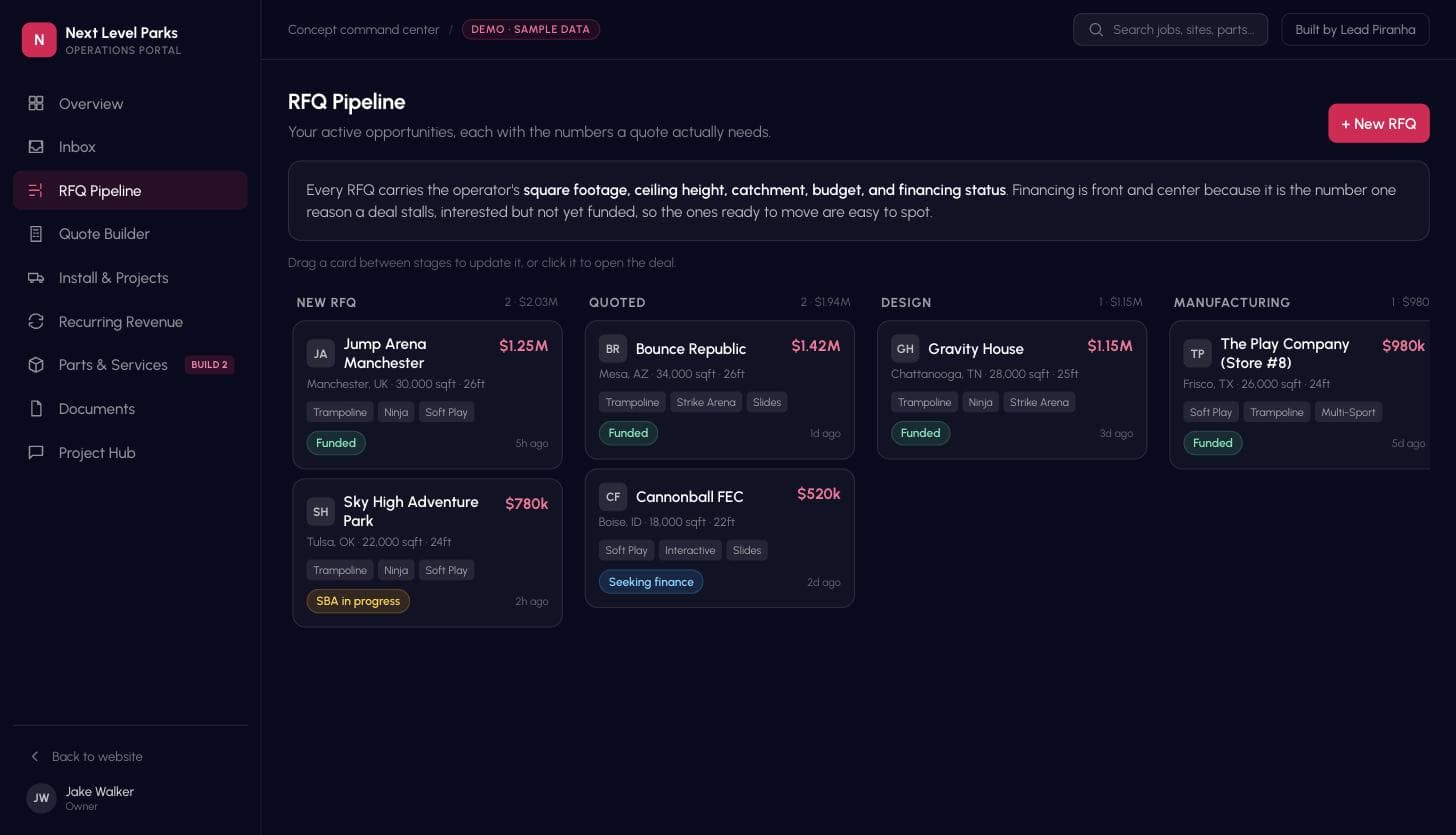
The chasing needs no pricing authority at all, only a view of which quotes are open, how old each one is, and what was quoted. That's a list, and a list can be worked by anyone, or by a system that sends the day-three message on its own and only involves a person when somebody replies.
The pricing is where you stay involved, but only for the rows that need you. That means the old quotes have to be somewhere searchable rather than in a folder on one machine, and the repeat work has to be findable by whoever is asking. Once that's true, the queue in front of you is the genuinely custom work, which is the part of quoting that actually deserves the owner.
We build both halves for equipment manufacturers, and we run them monthly rather than handing over a tool and wishing you luck. The full RFQ and quoting guide covers how the intake, the quote, and the follow up fit together across the whole order.
The Lead Piranha Playbook
You're doing the work of a team you don't have.
Every Tuesday I show you one job I automated for good. What it does, the tools by name, and the prompt to copy.
No spam, unsubscribe anytime.
Start With the Eleven You Already Sent
Before changing anything about how you quote, go back through the open quotes from the last month and send one message on each. It will take under an hour and it will tell you more about your close rate than any change to the process, because it turns eleven maybes into a set of yeses and noes you can actually work with.
Then look at what you learn. If most of those quotes were repeat work you priced yourself, then working faster won't help you much, and the fix is getting that repeat pricing out of your head and into a place somebody else can reach.
If you want to see how we put that together, our process overview walks through the whole build, from where quotes come in to who chases them, in the same order we'd do it for your shop. And if you'd rather have us chase the eleven with you, book a call and bring your quote log.